Facilitation Skills:
Soft Skills Training Design
For Principles of Instructional Design, I drafted a proposal for a training design to address a workplace need for developing facilitation skills in a low-stakes, high-feedback environment before staff are called on to use these skills in real meetings.
To design this training module, I followed the ADDIE process:
I confirmed a business need for a training-based solution through learner interviews;
I designed a training course using theories of andragogy and constructivism to select activities that responded to learner motivations;
I developed content explicitly customized for the company’s client needs and established processes;
I organized and facilitated a brief training and roleplay scenario with actual participants;
I proposed evaluation processes to supervisors and managers.
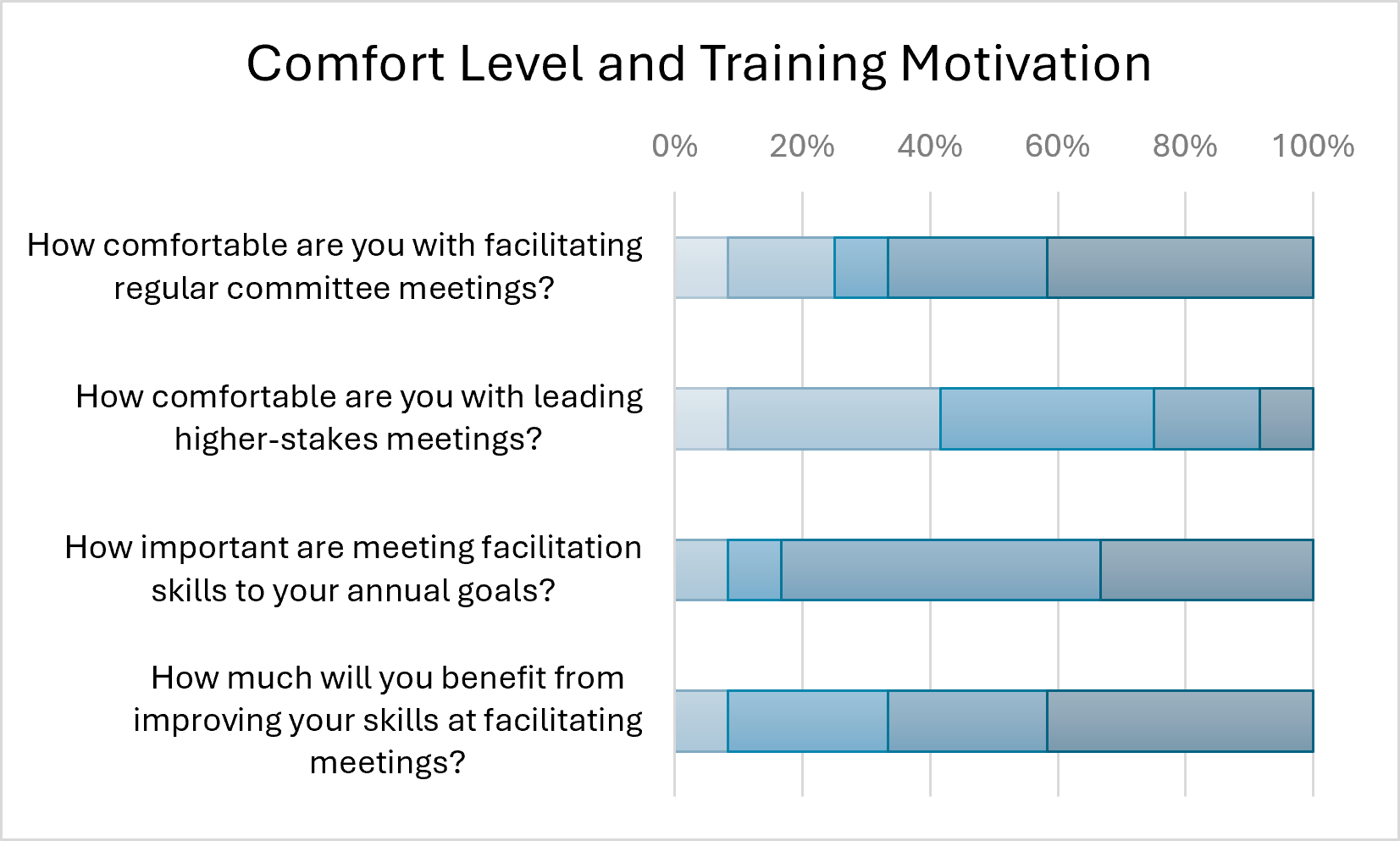
Survey results from actual learners.
This artifact meets Objective 2, as I designed the course objectives to meet authentic learner needs as described by the quantitative and qualitative results of surveys. I selected the performance-based roleplay activity based on cognitive learning theories to support problem-solving skills and designed additional materials to support learner motivation and connection between effort and success.
This artifact also supports Objective 6, because I was inspired to create this training based on my own experiences as a junior assistant, trying to learn facilitation skills through observation alone. Many industries do not have standardized training, and I wanted to empower junior staff to practice and experiment with a low-stakes simulated environment.