Capstone Project:
Informal Workplace Learning Course
For the Capstone, I chose to expand on my research into informal learning in digital/remote workplaces by developing a short course to learn self-regulation skills for informal learning experiences.
What happened?
For this project, I selected a learning problem to explore through the lens of instructional design and educational technology. Based on my research topic in the Inquiry course, and thinking about the subjects and skills I have not yet had the chance to explore, I chose to propose a solution for providing junior or transitioning workers in digital/remote workplaces with training to support informal learning awareness as well as support development of self-regulated learning skills.
Along with this training solution, I reinforced the course content with microlearning artifacts and a capture tool for documenting and reflecting on the informal learning experiences that occur in the scope of daily work.
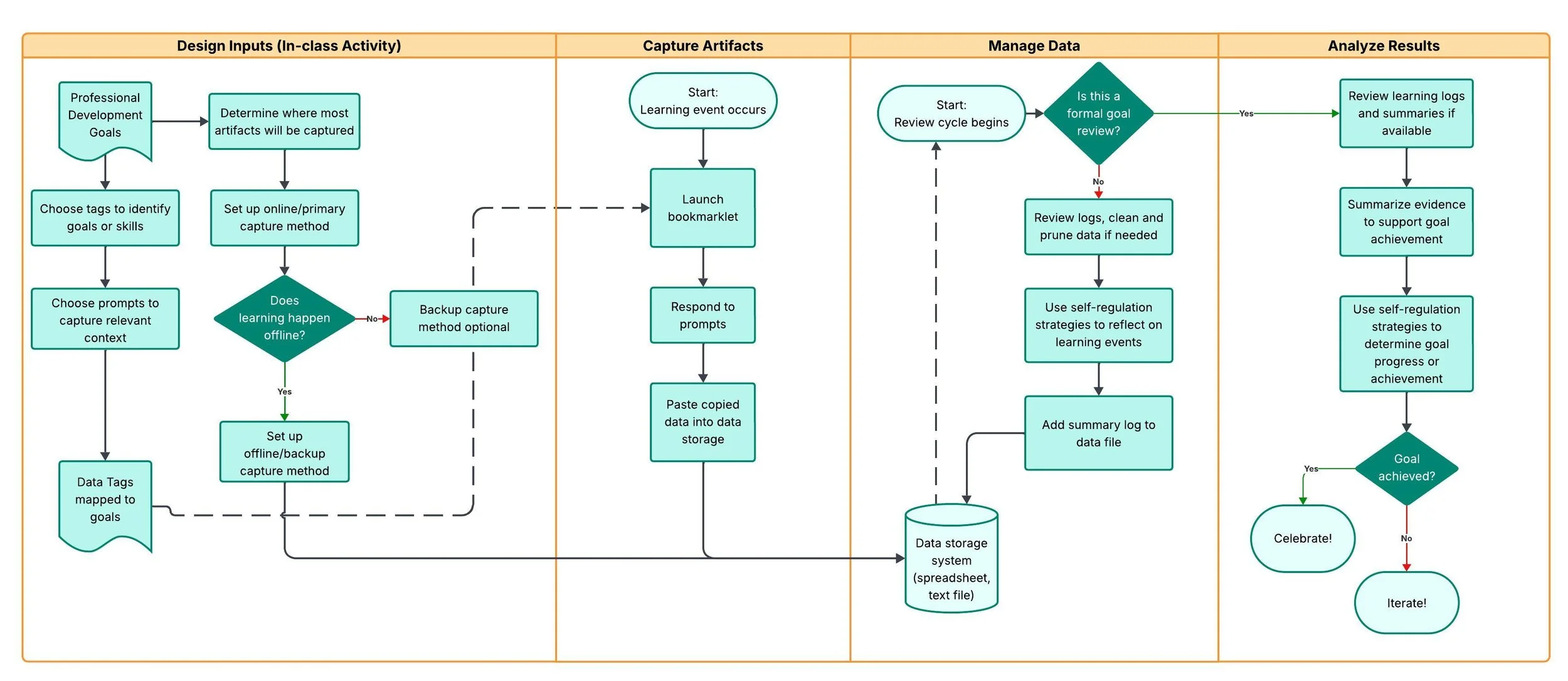
I planned the flow of course activities in Lucidchart so my peers and stakeholders could see where my design aligned with the course modules and planned activities.

Designing with AI
I challenged myself to learn more about using AI while developing this course. I used Anthropic’s Claude 4.6 Sonnet to produce and refine a small Javascript form that would capture user input about a workplace learning experience, then format the text for pasting into a document- or spreadsheet-based Learning Log.
Why does it matter?
The use of AI to develop portions of the capture tool, as well as the microlearning artifact development, meets JMU LDT M.Ed objective 7, exploring emerging ideas and their potential implications: I specifically wanted to explore how AI LLMs can support the work of instructional designers without introducing significant ethical issues or design flaws, and I wanted to understand possible use cases for microlearning that were instructionally supportive and deliberately implemented.
This project also provides strong evidence for objective 6, engaging in and reflecting upon one's own professional development. In our final class discussion, we agreed as a group that this project naturally guided us to synthesizing many elements of the different LDT courses and reflecting on how we could finally use our new skills to produce something tangible and meaningful to us. For myself, I see the development process behind this project as equally influential in my professional growth; not every stakeholder will share your objectives, much less your vision, and it is deeply important to work through that conflict directly and productively.